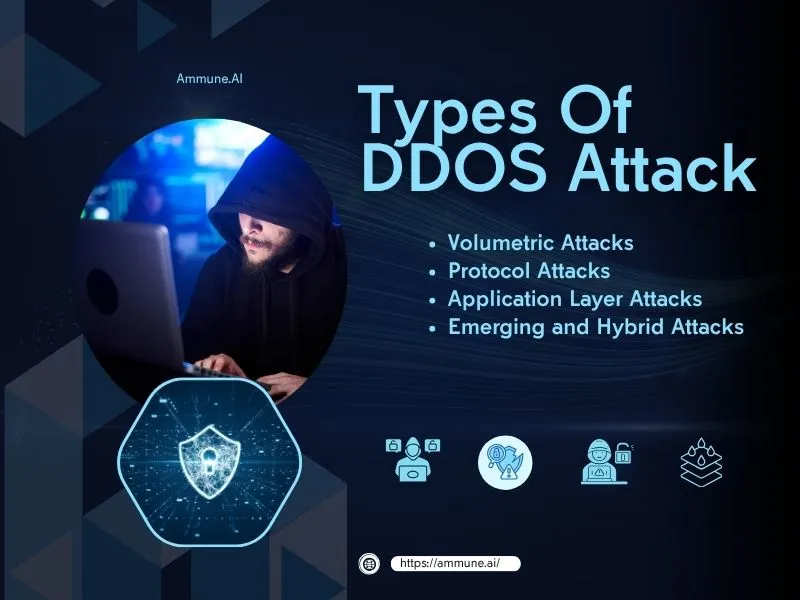
As the technologies evolve, many business operations move to virtualized space, rendering the business itself a potential victim of different types of cyber-attacks. An example of one such cyber-attack includes a Distributed Denial of Service Attack, which focuses on causing disruption to work of the application and network. It is recommended to take preventive measures by implementing application security services, which would not only help to protect against DDoS attacks but also ensure performance of software. Below is an article with a lot more information on different types of DDoS attacks.
What is a DDoS Attack?
A DDoS attack, or distributed denial-of-service attack, refers to a process in which multiple devices are hijacked by malware and directed at a single point, causing a surge of traffic beyond the handling capabilities of the system. As a consequence, the website or application becomes unavailable for users. DDoS attacks may vary from just a few minutes to several hours or even days.
Why Application Security Services Matter
Modern application security services have an important part to play in mitigating advanced DDoS attacks. Contrary to conventional security options which only concentrate on external security, such security services offer a high level of visibility regarding application behavior. These services offer comprehensive analysis and detection of traffic anomalies using intelligent systems and automation technologies. It is necessary for organizations to implement advanced and scalable security solutions in light of evolving attacks by cybercriminals in order to ensure continuous operation and an optimal user experience.
Types of DDoS Attacks
DDoS attacks can be categorized based on various criteria which include both the layer of the targeted system and the mode through which they affect service.
1. Volumetric Attacks
The most common form of DDoS attacks includes volumetric attacks aimed at using up the full bandwidth of the network or the server. During such attacks, the malicious actors send a massive amount of traffic to the target's website until the target is completely overwhelmed with the traffic. The typical examples of volumetric attacks include UDP floods, ICMP floods, and amplification attacks using DNS or NTP servers, which create excessive amounts of traffic that cannot be managed without advanced security services capable of filtering out the malicious traffic.
2. Protocol Attacks
Protocol attacks or state exhaustion attacks target vulnerabilities in the protocols and try to exhaust server resources through sending specific kinds of traffic. Unlike volumetric attacks, protocol attacks typically use a small amount of bandwidth because they do not depend on the traffic amount, but on the way in which the targeted system handles traffic. Examples of protocol attacks are such techniques as Ping of Death, Smurf attack, and SYN flood, where the attacker sends a great number of request without finishing the connection process. As a result, the server runs out of available resources.
3. Application Layer Attacks
These attacks are advanced in nature and are aimed at a particular web application or service. They are quite hard to detect due to their capability of mimicking the behavior of genuine users. While the main objective of other types of attacks is to overwhelm the bandwidth of the system, application layer attacks aim to exhaust the CPU, memory, or even database resources. HTTP flooding and Slowloris are some examples of application layer attacks, where the former involves the sending of many request messages to servers, while the latter focuses on keeping connections alive to exhaust server capacity. These attacks are quite disruptive in nature and need intelligent application security services to combat them.
4. Multi-Vector/ Hybrid Attacks
A multi-vector DDoS attack involves the launching of several attack types simultaneously against a network or website. For example, an attacker might choose to launch a volumetric attack to consume the network bandwidth while performing an application layer attack at the same time. To tackle such attacks, organizations need efficient security services.
Multi-vector DDoS attacks use several kinds of attack techniques simultaneously to increase disruption and make it harder to protect systems from potential damage. An example would be performing a volumetric attack along with an application layer one. It makes sense that multi-vector attacks are extremely hard to stop through conventional protection, as both layers have to be protected against various kinds of attacks.
DDoS Prevention Through Application Security Services
DDoS attacks require prevention and mitigation techniques that would prevent any disruption from happening and keep your system operational and available. With adequate security services, you will be able to protect your network and applications.
When it comes to prevention techniques, load balancing and distributing the traffic among the several servers will significantly reduce the chances of an attack.
Such solutions help protect against DDoS attacks by monitoring the behavior of incoming traffic and blocking suspicious activity. Traffic analysis and filters are utilized to ensure that only safe traffic reaches the targeted server while filtering all suspicious activities. Moreover, automated response and mitigation processes are performed within minutes, thus preventing DDoS attacks from becoming more harmful to businesses. Content delivery network (CDN), traffic filtering, rate limiting, and Web Application Firewall solutions help protect the target server efficiently.
Conclusion
DDoS attacks are becoming increasingly common and harmful, posing significant risks to companies regardless of their size. The types of DDoS attacks range from volumetric and protocol to application layer and multi-vector, each of which should be approached differently during the protection process. To prevent DDoS attacks, companies need to know about the possible forms of cyber threats and provide high-quality application security services.
FAQs
1. What are the types of DDoS attacks?
DDoS attacks have four different types like volumetric attacks, protocol attacks, application layer attacks, & multi-vector/hybrid attacks.
2.How does application security help prevent DDoS attacks?
Application security monitor and analyze traffic on a network for any potential cyber attacks.
3. Is it possible for a small business to become a target for a DDoS attack?
Yes, cyber attackers like to target companies that lack adequate security against cyber-attacks.
4. Which one of the DDoS attacks is hard to detect?
Application layer attacks are difficult to identify as they mimic the legitimate users.