As companies move further to embrace digital technology in their operations, cybersecurity dangers have never been more threatening. Among the greatest cybersecurity risks that companies are facing today is a Distributed Denial of Service (DDoS) attack. Such attacks are capable of crashing websites, apps, APIs, and networks in a matter of seconds and thus cause massive economic losses and reputational damage.
Any online business could be a target for such an attack from eCommerce and bank platforms to cloud computing and online gaming services. It is thus crucial that businesses adopt the use of advanced api security as well as preventive measures against DDoS attacks to protect their assets.
What Is a DDoS Attack?
Distributed Denial of Service (DDoS) attacks are among the cyber attacks that target the functioning of a website, server, API, or any other asset. In general, the objective of launching such an attack is to inundate the website with an influx of traffic originating from multiple hacked machines on the internet.
The key purpose of launching a DDoS attack involves saturating the available bandwidth, RAM, CPU utilization, or the total capacity of the server to such an extent that legitimate users are unable to access the services provided. At times, an organization could experience full outage lasting several hours or even days. DDoS attacks are no longer primitive today. Cybercriminals have access to new targets such as APIs, cloud-based services, payment gateways, and applications used by enterprises. This is the reason why many businesses invest millions of dollars to ensure that their cybersecurity systems are able to withstand the increasing threat landscape.
Why DDoS Attacks Are Harmful for Your Business
In addition to creating short-term disruption, DDoS attacks can negatively impact your business in other ways, such as disrupting customer services, damaging your business’s reputation, and incurring operational costs. For instance, eCommerce websites suffer great losses when down for just a few minutes because the customers leave and make their purchase elsewhere. In case of banks and healthcare organizations, DDoS attacks pose regulatory and data security risks.
Finally, the attackers will use DDoS attacks as a strategy to create distractions in order to launch other forms of attacks on the attacked network or web server. It is therefore important to be adequately protected from DDoS attacks.
What are the Methods To Prevent DDoS Attacks
To be able to protect yourself from DDoS attacks, you need to use various security measures that will help protect your system from such attacks. You should have multiple lines of protection against any attack rather than having only one.
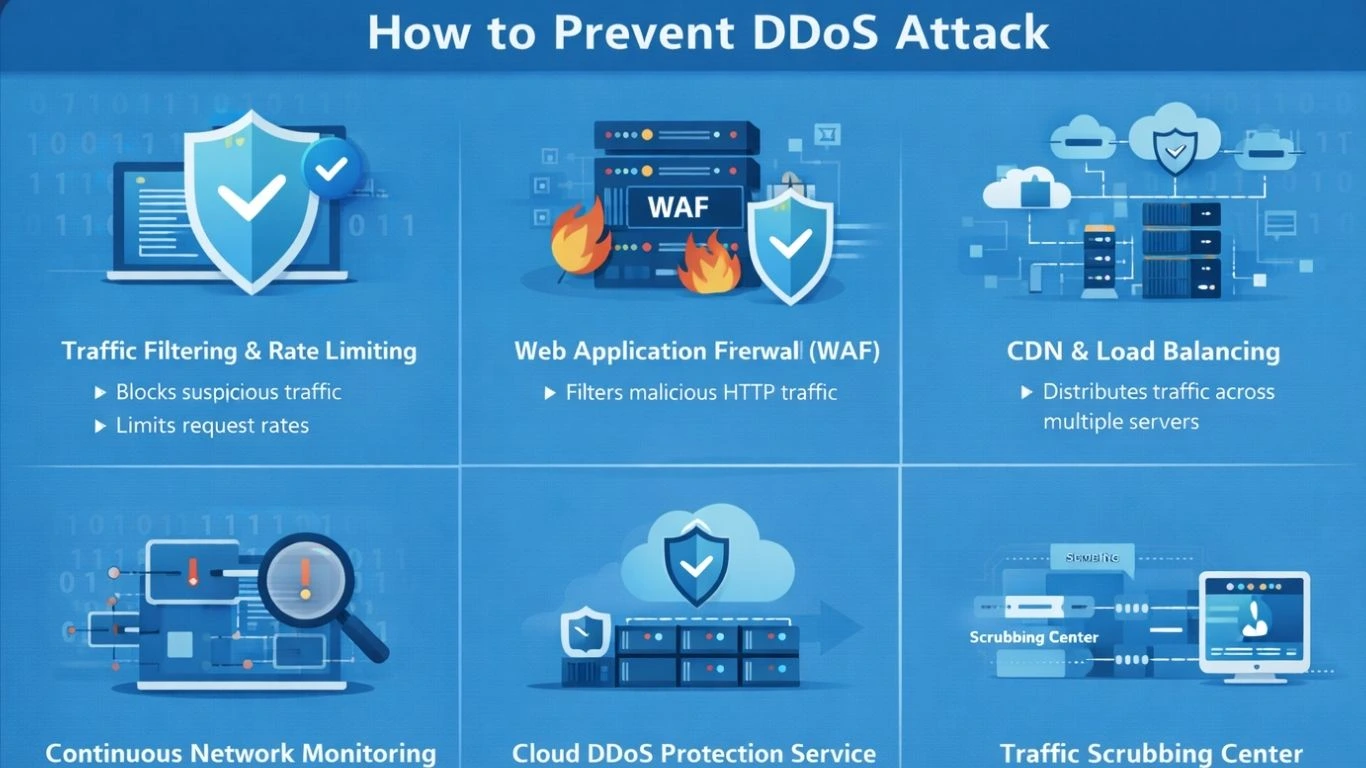
Use Web Application Firewalls (WAF)
A Web Application Firewall protects your web application. It checks all the requests sent from the users' browsers to make sure they do not pose any threat.
The main functions of WAFs are detecting malicious bots and protecting your app from attacks such as HTTP floods. Moreover, today's WAFs utilize machine learning and behavior analysis techniques to enhance their abilities for detecting threats. Using WAF is one of the most efficient approaches for protecting web applications from external threats.
Implement Rate Limiting
Rate limiting limits the frequency of requests a user/device may send during some time. You would use rate limiting so that attackers cannot send multiple requests to your site at once.
In case an attacker tries to send many simultaneous requests using some IP address, then you can use rate limiting to prevent this. Most API security support complex rate-limiting algorithms for protection against attacks by bots & brute-forcing.
Use Content Delivery Network (CDN)
Content Delivery Network (CDN) divide your site traffic among different servers located across different geographical locations. The system is meant to ensure the decreased traffic pressure on the primary server.
In case of a DDoS attack, the CDN will be able to handle the traffic surge by redirecting requests to various CDN nodes rather than a single server. Apart from offering better security protection, Content Delivery Networks can be used to increase the speed of your website and improve its performance.
Use Load Balancers
Load balancing technology is aimed at the even distribution of traffic between various servers. It means that in case any server experiences high traffic rates, the traffic will be redirected to other servers without interrupting operations.
The use of load balancing technology improves the availability and accessibility of resources. Most cloud-based companies combine load balancing with auto-scaling services to handle unexpected increases in traffic volumes.
Enable Traffic Monitoring & Analytics
Network traffic monitoring is one of the critical security practices that allow organizations to detect suspicious activities and potential threats. Analytics tools are used to track the trends in traffic and analyze suspicious user activity.
Use DDoS Protection Services
DDoS-specific protection services work specifically to filter out malicious traffic & protect the target infrastructure. They use modern filtration methods, AI-based detection, & threat intelligence to stop threats. Many large companies combine DDoS protection tools with their applications' security to better protect them.
Ensure Proper Secureness of APIs
APIs are extremely important in today's world, this is why they frequently fall victim to attacks. Without proper API security solutions, it may lead to exposure of sensitive data & increase the risk of service interruptions.
It is very important for enterprises to secure their APIs using approaches like authentication, gateways, tokenization, encryption, & access control.
Provide Network Redundancy
Network redundancy is an important aspect in case of cybersecurity incidents and server crashes. To make sure you have some alternatives to work with during a problem, businesses need to use network redundancy strategies.
A network with server redundancy and cloud computing capabilities is extremely beneficial when facing a DDoS attack.
Essential Tools To Avoid DDoS Attacks
Certain cybersecurity products come equipped with specific security features which enable organizations to identify, analyze, and respond to DDoS attacks. Additionally, the use of appropriate security tools ensures continuous provision of web services while enhancing network security, performance, and API security.
Cloudflare
One such solution is the Cloudflare service that can prevent DDoS attacks and filter traffic. Through its global network system, Cloudflare protects users' websites against malicious traffic to prevent their downtime. It provides automated systems and threat intelligence services which can prevent any attacks from harming your website. In addition, this service improves the performance and security of your website, making it perfect for people with high levels of traffic on their websites.
AWS Shield
Another tool for protecting websites against DDoS attacks comes from Amazon Web Services. AWS Shield is a DDoS defense service provided for websites hosted using AWS resources. The tool automatically detects and blocks DDoS attacks while keeping websites operational. Shield by AWS works together with other services offered by AWS to ensure that applications, APIs, and workloads on the cloud can be secured.
Akamai
Akamai Technologies ensures that organizations have enterprise-grade DDoS attack protection through intelligent traffic steering and threat detection tools.
Akamai has an extensive global network, which helps organizations maintain the performance level of applications amid cyber-attacks. In addition to this, Akamai provides advanced analytics and monitoring tools that can detect suspicious activity within a company’s cybersecurity system.
Imperva
Imperva protects digital assets and applications through its solutions for web application security, API protection, bot management, and DDoS mitigation.
In addition to this, Imperva uses AI technologies to detect malicious traffic patterns. Imperva also provides comprehensive security for enterprises.
F5 BIG-IP
These advanced features allow the organization to protect itself from any form of cyber attack. The platform can assist in improving application availability and performance through the effective distribution of traffic among different servers.
Conclusion
DDoS attacks continue to pose a threat to organizations even today and have become more sophisticated. This makes cybersecurity one of the most important issues that need attention by any modern company since it can lead to significant problems and damages.
Using layered security measures such as firewalls, CDN services, traffic balancing, monitoring traffic, and using API security solutions can help mitigate the risks of being subjected to attacks. With any organization ready to invest in high-quality api security techniques, there will definitely be total protection available for their online resources. It is crucial to protect their assets from DDoS attacks to ensure their performance & security optimization.
FAQs
1. What is a DDoS attack?
It is a type of attack involves in flooding a web server or network with heavy traffic, resulting in making the website unreachable & inaccessible.
2. How come businesses protect themselves against DDoS attacks?
There are many methods to prevent businesses from DDoS attacks. Some of the methods include firewalls, CDNs, load balancing, and API security.
3. Why are APIs a preferred target of DDoS attacks?
APIs become the target of DDoS attacks because they connect applications & services. Weak APIs can lead to system overload.
4. How do API security solutions protect from DDoS attacks?
Advanced api security solutions detect malicious API requests and prevent them. Thus, these solutions can protect applications and APIs.
5. Which technologies can be used to prevent DDoS attacks?
Cloudflare, Imperva, & Akamai Technologies are few of the most common tools to prevent DDoS attacks.