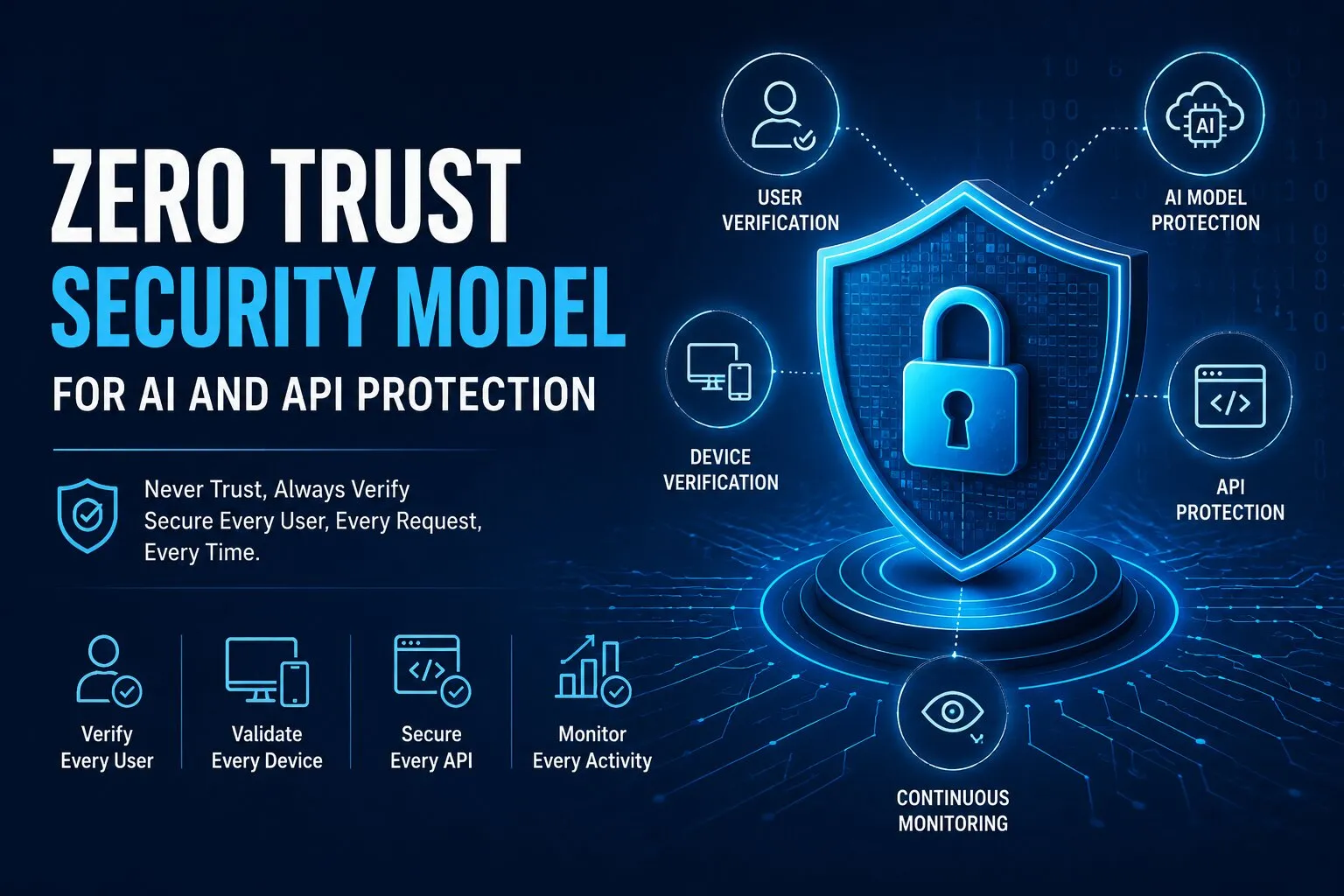
In today's digital world, Artificial Intelligence and APIs play an important role. These technologies have been implemented by businesses to automate processes and innovate. But due to reliance on these technologies, companies have increased their vulnerabilities. In an environment in which every device, user, and application interacts through the cloud network, traditional security models are no longer effective.
That is why organizations need Zero Trust Architecture. Based on the assumption that there should be no default trust for any user, device, or application, Zero Trust can help protect these critical assets from new attacks. By adopting API security best practices together with a Zero Trust approach, companies can have a stronger protection mechanism against modern cyber threats.
What is the Zero Trust Security Model
Zero Trust Security Model is stated as the cybersecurity model which has "never trust, always verify" as the underlying principle of its concept. The difference between the Zero Trust Security model and any other security model is that there is no element of trust associated with this model after the user accesses the network.
Accesses have to be validated constantly and verified before access is granted. Identity authentication, least privilege, monitoring, and threat detection are some of the important components of Zero Trust Security Model.
Why Does AI Require Zero Trust Security?
AI solutions deal with tons of confidential information, which attracts cybercriminals to use such systems in their attacks. The information processed by artificial intelligence includes personal customer data, money accounts, corporate property, and other insights. If any malicious actor gets access to such AI systems, the result will be catastrophic.
With Zero Trust technology, all interactions with data, algorithms, models, and infrastructure elements are validated by default. Zero Trust protects companies from attacks and allows them to avoid model theft, data poisoning, and prompt manipulation.
The Risk of Unauthorized Access
Most artificial intelligence tools work together with various databases, cloud storages, and other software programs. One compromised account might give an attacker unlimited access to all connected databases. With Zero Trust security solution, companies minimize such risks.
Protecting Sensitive AI Data
Most data sets used in the training of AI systems are classified and confidential and need to be secured throughout the AI life cycle. Zero Trust helps guarantee only authorized people and systems gain access to this data.
Zero Trust Core Principles for AI and APIs
The success of the Zero Trust approach is rooted in core principles aimed at minimizing risks and increasing security measures for all digital assets.
Verification of All Identities
All access requests need to be verified regardless of the access point location, whether inside the network or external. This applies to any user, device, application, and automation tools utilized for accessing resources. Modern verification techniques like multi-factor authentication improve the level of security at the point of access and ensure there is no malicious intent.
Principle of Least Privilege
In order to avoid the impact of such attacks, all permissions must be limited just enough to perform required functions. This helps reduce the attack surface from any further intrusion.
Continuous Verification
After the initial verification is done, continuous verification should be applied. With constant monitoring and identification of anomalies, companies will have more chances to identify and react to emerging issues.
Micro-Segmentation
With micro-segmentation, infrastructure is divided into smaller parts that are completely isolated from each other. This principle prevents further propagation of the attack.
Why Does Zero Trust Improve APIs Security?
The adoption of Zero Trust security enhances API protection by strengthening different vulnerabilities in various ways.
Stronger Authentication Techniques
The new methods of authentication consist of OAuth 2.0 & token-based authentication methods which provide better security than the usual username-password approach. Companies that adopt API security best practices always look into enhanced authentication mechanisms to avoid any unauthorized access.
API Authorization Security
Authorization defines what users and applications are allowed to do post-authentication. Zero Trust utilizes granular authorization methods through roles, statuses of devices, and risks assessment to minimize chances of attacks.
Threat Detection In Real-Time
Monitoring of the API traffic enables identification of any threats and odd behavior that would otherwise go unnoticed. The security team acts quickly to neutralize potential risks to prevent any breach.
Protecting AI Models Through Zero Trust Architecture
AI models are essential assets for any business that requires proper protection from attacks during the entire life cycle.
Protection of Training Data
Training data plays a significant role in the effectiveness of an AI model. It means that the training data needs to be safeguarded against any form of attacks. The Zero Trust architecture guarantees secure access and full visibility.
AI Model Access Security
The threats that could be posed to AI systems include stealing, reverse engineering, and manipulation. Putting strict measures on authentication and authorization helps ensure that only authorized persons and processes will communicate with the AI models.
AI Interactions Monitoring
Constant monitoring enables one to see how AI is being used. This allows you to spot any unusual activity, conduct investigations about security breaches, and secure your system further.
Conclusion
One of the most effective frameworks for ensuring cybersecurity in the AI system and API space is the Zero Trust Security Model. Through the process of continuous identity verification, least privilege access enforcement, activity monitoring, and segmentation of resources, businesses can effectively minimize their risk of falling prey to any form of cybercrime.
As AI becomes increasingly adopted in various industries, the Zero Trust framework provides a strong platform on which companies can leverage secure AI and API environments. Adoption of API security best practices along with the Zero Trust approach increases protection from the emerging threats even further.