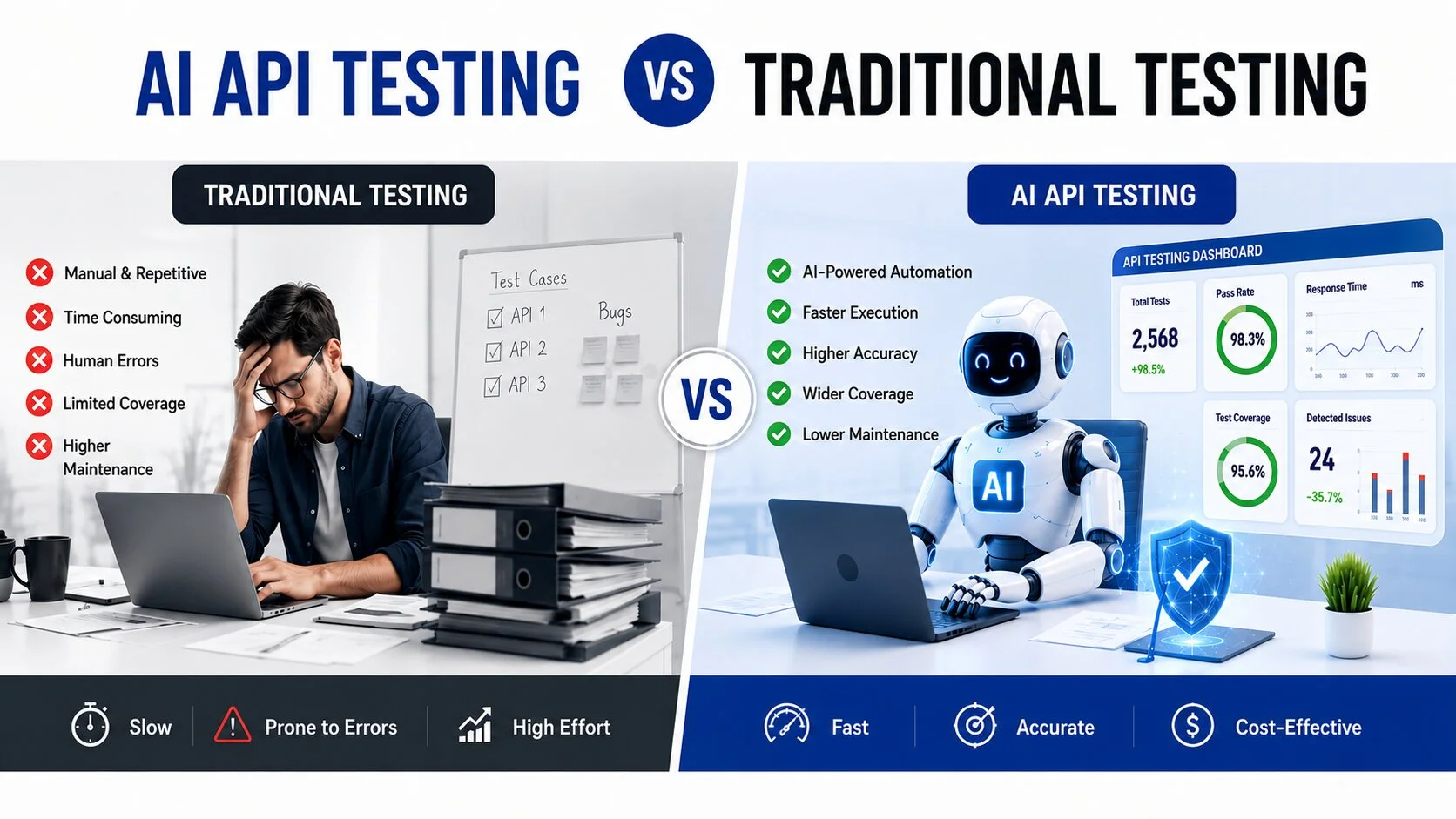
With the growing complexity of the software system, there is a need for advanced testing techniques which can help meet current needs. The traditional testing technique has been used in the field of Quality Assurance for decades and has helped identify issues in software products for making them reliable. With the increasing presence of artificial intelligence and API-based applications, there is a need for more intelligent and flexible testing techniques that can handle complex applications easily. Thus, AI API testing is becoming popular with its advantages over traditional testing.
What is Traditional Testing
Traditional testing means the conventional techniques of ensuring software quality through the process of test design, execution, and maintenance of the test cases. These may include functional, regression, integration, and other types of testing.
The main benefit of using traditional testing lies in validating the logic implemented in the software. The tests created will enable testing the logic from a human perspective and checking usability and workflow of the product being tested. However, the problem appears when there are complex interactions of various components, including via APIs.
How Traditional Testing Works
Traditional testing involves an organized approach where requirements are studied, test cases are created, and testing is conducted manually or using rule-based testing tools. In situations where changes need to be made to the software, modifying existing test cases becomes a burden.
Limitations of Traditional Testing
The biggest limitation associated with traditional testing is its lack of capability to keep pace with rapidly evolving software. Test case generation for an enterprise-grade application, which consists of hundreds of APIs, may become highly challenging because of the creation of many test scenarios. Traditional testing fails to recognize certain patterns and anomalies which can be recognized by AI-based systems easily.
What Is AI API Testing?
AI API testing combines artificial intelligence with API testing processes to which makes it more accurate and efficient. With AI, testing does not depend only on predefined scripts but is based on previous tests and the ability to detect patterns and generate new test cases, thus enhancing coverage.
Today, applications use APIs to interact between services, cloud computing, mobile application, and third parties, and AI API testing is used to check if the application's interactions are performed correctly while keeping up with changes in application functionality.
Intelligent Test Generation
Artificial intelligence can examine application workflows and automatically generate appropriate test cases, thus reducing time required for preparation and making sure that API endpoints are covered by many tests.
Automated Defect Detection
While classic testing techniques rely on pre-established requirements, AI-enabled tools can recognize any deviation in the application's performance and alert testing experts about problems.
Major Differences between AI API testing and Traditional Testing
Traditional testing and AI API testing have significant differences in terms of their methodology, efficiency, and ability to address modern challenges in the software development lifecycle. While traditional testing implies a set of manual processes and test cases, an AI-driven testing approach introduces various advantages in form of automation and other features, which can enhance the testing process itself.
Adaptability
One of the distinguishing features of these two testing types is adaptability. Traditional testing requires creation and modification of fixed test cases each time an application's functionality or workflow is updated by developers. On the contrary, in AI API testing, the system constantly adapts to the behavior of the application and can adapt to the update process without additional actions by users.
Efficiency
Second, the process of AI API testing tends to be much more efficient comparing to traditional testing. Namely, in order to execute traditional testing, there is always needed to invest a lot of time and effort into creation and modification of test scripts. However, with AI API testing, many operations become automated and thus do not require extra time and efforts.
Accuracy and Test Coverage
Accuracy is one of the most important criteria in quality assurance. In some cases, the traditional method of testing may overlook certain problems as a result of insufficient test coverage or even due to human errors. AI API testing allows for data analysis and finding hidden patterns and anomalies within it, providing a higher degree of accuracy than conventional testing methods.
The Importance of Security for Modern Testing
As cyber attacks are constantly growing in number, the necessity to secure software became important. In particular, APIs can be considered gateways to sensitive business and personal information and therefore become vulnerable to attacks. AI API testing can enhance this aspect by continuously analyzing APIs and looking for possible vulnerabilities.
Businesses that follow appropriate API security best practices can minimize their risks of suffering from various security breaches. Moreover, AI testing solutions will help detect any possible security threats automatically.
AI to Boost API Security
With the help of advanced AI analytics, businesses are able to look for suspicious traffic patterns & discover security threats that may be missed by traditional methods. As a result, companies can ensure maximum security for application environment without affecting its performance.
Continuous Validation of APIs' Security
Instead of periodic tests performed manually, continuous validation with AI testing tools allows businesses to protect their APIs and applications.
Conclusion
Although AI API testing and traditional testing have a common objective of producing top-notch software, they approach the objective from entirely different perspectives. While traditional testing gives you human judgment to test your software, AI API testing will bring you automation, flexibility, and analysis. In an ever-growing software ecosystem, AI-based testing is increasingly becoming a necessity for companies striving for efficiency, scalability, and even safety.